Future Astrophysicist Avery Finds a Home in the Family Fellowship
Avery’s passion for science began with atelescope from their mother, fueling a curiosity that only grew as they got older. Later, after losing both birth parents, Avery relied on teachers, mentors, and their “bonus” foster family while continuing to explore that passion for science in college. Today, Avery calls themself a “statistical anomaly” for being among the 3-4% of foster youth to go to college, the 1% of Black women in STEM, and the 0.1% of former foster youth to pursue a doctorate.
At last year’s annual Fellowship retreat, Avery gave a deeper look into their continuing journey into the world of astrophysics as a former foster youth and a thriving Black woman in STEM.
Making Waves in the Academic Community
Avery is a rising star in their fourth year of undergraduate school, working toward their Bachelor’s degree in Astronomy and Astrophysics with a double minor in education and Portuguese. Avery is leading the way for other Black women in STEM, and former foster youth pursuing higher education as they build a remarkable career in scientific research and the space community.
They plan on attending graduate school and earning a Ph.D. in Astrophysics to research cosmology, astroparticles and astronomical instrumentation.
If you think that’s impressive, just wait until you hear what else they’ve been up to!
Avery serves as the chair of theUndergraduate Majors/Minors in Astronomy and Astrophysics Committee at The Ohio State University, helping bridge the gap between students and department faculty members. “We’ve held yearly dinners for international students, where out-of-state students can’t go back home for the holidays. We’ve steered Undergraduate Town Halls to hear the concerns of undergraduates in the department. We’ve had fundraising events as well,” they note.
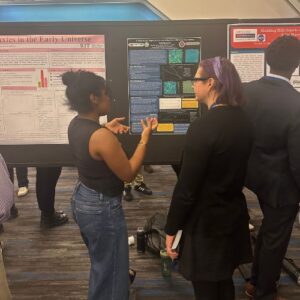
They’ve spent time on the UC Santa Cruz campus looking at brown dwarfs and substellar objectsand at the Flatiron Institute in Manhattan on cosmic microwave background radiation and galaxy cluster interactions, while also teaching groups and presenting their work abroad in Europe and for organizations like theAmerican Astronomical Society and theNational Society of Black Physicists. “This past year, I was actually the keynote speaker for the conference!” Avery reports.
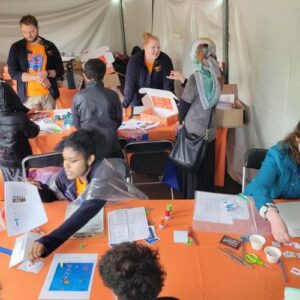
As a former science educator at COSI in Columbus, Ohio, Avery taught groups about native ecosystems and led electric workshops. “I’ve had the honor to work with live animals and teach the audience about how to be mindful about native ecosystems in Ohio.” This summer, they continue their work as an educator at the Columbus Zoo and Aquarium, sharing their love of science with audiences there.
Despite these successes, their path has not been without obstacles.
“My first year of undergrad was really rough for me,” Avery shares. As one of the few Black students in their physics and astronomy classes, they often felt the weight of discrimination. Avery explains that the low representation of Black women in STEM fields can emerge from a lack of financial support—and from racism experienced in academia. “And unfortunately,” they say, “I have experienced that firsthand.”
Despite those challenges, they persevere.
Avery’s work across space-related fields reflects not only academic excellence but a commitment to long-term scientific development, expanding access for others who want to join the field, and uplifting Black scientists along the way.
Finding Support Through Bonus Family, Mentors, and the Fellowship
Throughthe Family Fellowship scholarship, Avery has found the support, guidance, and opportunities that continue to propel them as a rising Black woman in STEM, combining research, teaching, and leadership to make their mark in astronomy and physics.
After losing their birth parents, Avery leaned on teachers, mentors, and their “bonus” family—how they refer to their foster family—through the ups and downs of life after foster care. “I had a lot of people who saw the potential in me when I didn’t see it in myself from the beginning,” they say, highlighting how critical this support was in early college years.
Avery’s support network began with their families—foster, biological, and chosen. “My parents—they got divorced when I was pretty [young],” they explained. “By the time my dad had passed away, it was especially my bonus family—the family that I went through when I was in foster care, who really took me on…I realized that I had this big support system of both my biological family, my chosen family, my bonus family, too.”
Avery says they sometimes felt they had to choose who their “real” family was, until they realized they didn’t have to. “I came to the conclusion that everyone’s my family!” Avery says proudly.
They have also found a special place with one of their research advisors and mentors:
“One of my mentors is Dr. Caprice Phillips. She’s also a Black woman, a former graduate student in my department, and she kind of took me on as her academic daughter. I would say…Caprice [is my family]. When my dad passed away on Thanksgiving, I went to her and said, ‘My dad died today.’ I felt vulnerable during the first few months—she kept giving me that drive of, ‘You’re going to be okay. This is a rough time, but you’re going to be okay.’ So through the mix of all these different support systems, especially during the holidays when it’s rough, I’m very thankful.”
Care That Goes Beyond the Classroom
Throughthe Family Fellowship program, Avery found a unique layer of support. Surrounded by a team of peers and mentors who understood the unique challenges of being a former foster youth, Avery can navigate their higher education with a compassionate team standing behind them.
“A lot of opportunities I wouldn’t have had if it wasn’t for the Family Fellowship,” they reflect, “I used Fellowship funding…to go back home, [travel to] different events…and I use it for housing. They paid for my registration for the National Society of Black Physicists. I wouldn’t have been able to have the network opportunities within physics and astronomy if it wasn’t for the Family Fellowship.”
But beyond financial support, the Fellowship offers something deeper: safety.
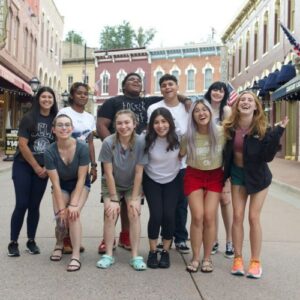
They remembered attending their first Fellowship retreat—a weekend gathering where Fellows come together to connect, reflect, and build community—just one month after their father passed away.
“I think that was like a month right after my dad passed away. I’m in this process of mourning,” they say. Only one person knew the full weight they were carrying, their mentor. “[He] was very well aware…I was taking time to just calm down or just to get a breather.”
Still, they never felt alone. “Everyone was so welcoming. Everyone made sure that no one was treated differently.”
In a season marked by grief and uncertainty, that quiet acceptance meant everything.
“Being part of the Family Fellowship made me realize that I’m not alone,” they say.
Another Found Family in the Fellowship
Even without what Avery calls a “traditional” family structure, they have found parent figures and lifelong champions within the Fellowship community.
“Even though I don’t have the traditional sense of a mother and a father, I have different motherly figures and fatherly figures. So, [my Fellowship mentor], for me, I would see as a fatherly figure in my life. And I get so happy when I share with him, ‘Hey, I was in this Nature article,’ or ‘I was a keynote speaker.’ I sent him my graduation invitation, and I was like, ‘Did you get it in the mail?’ So it’s always nice to have that support.”
That support extends beyond one person. “Even with the Family Fellows, whenever we come on this retreat, it’s amazing to feel that love and that warmth. To hear everyone’s ups and downs and how they’re working through everything, too.”
Rewriting the Narrative
For much of their journey, Avery is aware of the odds: 3–4% of foster youth attend college. 1% are Black women in STEM. 0.1% are former foster youth progressing to a doctorate.
But through the Family Fellowship, those statistics no longer define them.
“I do not have to be that 1% anymore. I don’t have to be the 3 to 4% anymore. I don’t have to be a 0.1% anymore,” they say. “And I’m able to spread that love for science in a way that is accessible for all within the universe, too.”
With the support of their bonus family, mentors, and the Family Fellowship community, Avery doesn’t have to navigate the universe alone. They’re building pathways so others can follow. And as they continue their journey toward a doctorate in astrophysics, one thing is certain: they aren’t just defying the odds—they’re redefining them.